
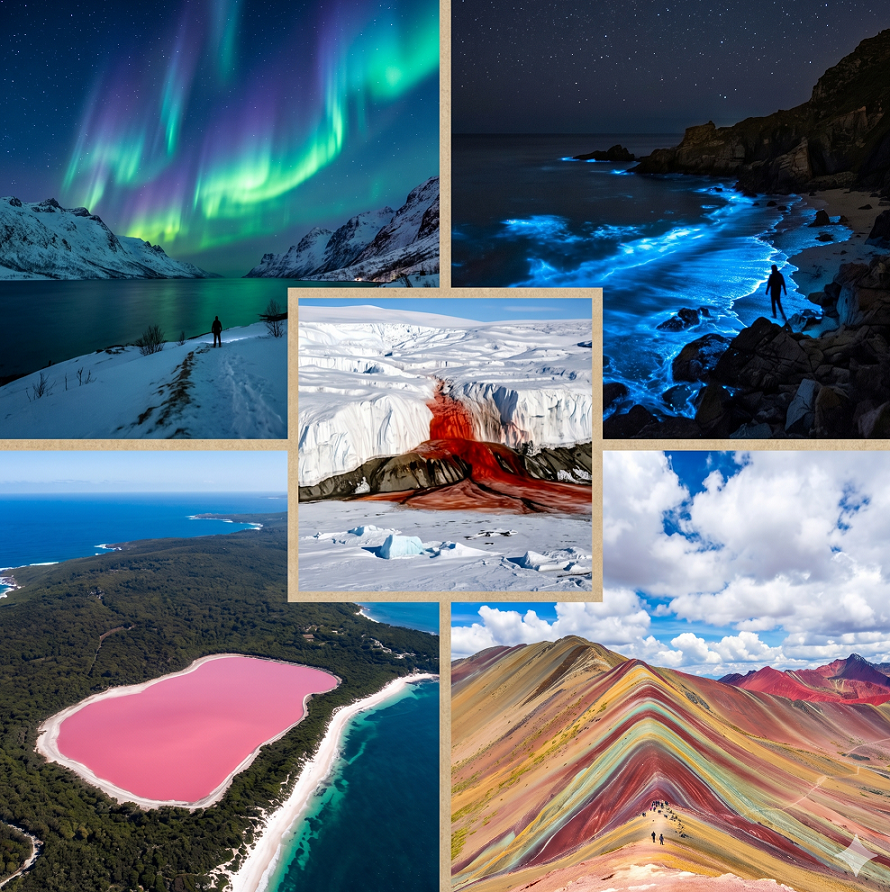
Our planet is home to landscapes so surreal they defy imagination. From neon-glowing coastlines to mountains painted in kaleidoscopic hues, these five destinations offer a front-row seat to the world’s most spectacular natural phenomena.
1. The Northern Lights (Aurora Borealis)
The Aurora Borealis is a mesmerizing celestial display caused by charged particles from the sun colliding with gases in Earth’s atmosphere, creating dancing ribbons of green, violet, and crimson light across the night sky.
Best Places to Experience It
- Tromsø, Norway: Located in the center of the aurora oval, offering excellent infrastructure and coastal scenery.
- Fairbanks, Alaska, USA: Boasts clear interior skies and consistent activity.
- Reykjavík & Abisko: Iceland offers island-wide viewing, while Abisko National Park in Sweden benefits from a unique microclimate that minimizes cloud cover.
Traveling to the Destinations
To reach Tromsø, fly into Tromsø Airport (TOS) via Oslo. For Alaska, fly directly into Fairbanks International Airport (FAI). Most Aurora destinations feature well-maintained roads, but winter driving conditions can be treacherous; booking an guided excursion with local experts who track weather and solar data is highly recommended.
Best Time to Experience It
The ideal viewing window spans from late September to early April, when the Arctic nights are at their darkest. Peak viewing hours usually fall between 9:00 PM and 2:00 AM.
2. Bioluminescence (Planktons)
Bioluminescence occurs when microscopic marine organisms called dinoflagellates emit a bright blue glow when disturbed by wave movement, boat wakes, or a swimmer’s stroke, transforming the ocean into a glowing mirror of the night sky.
Best Places to Experience It
- Mosquito Bay (Vieques, Puerto Rico): Formally recognized as the brightest bioluminescent bay in the world.
- Toyama Bay, Japan: Famous for its glittering blue shorelines, driven by bioluminescent firefly squid alongside plankton blooms.
- Luminous Lagoon, Jamaica: Where warm, shallow waters create a brilliant, consistent neon glow.
Traveling to the Destinations
To experience Mosquito Bay, fly into San Juan, Puerto Rico (SJU), take a regional flight or ferry to Vieques Island, and book a licensed night-kayaking tour. For Toyama Bay, take the Hokuriku Shinkansen bullet train directly from Tokyo to Toyama City.
Best Time to Experience It
Bioluminescence is visible year-round, but it is highly dependent on light conditions. The best time to visit is during a New Moon phase (when the sky is darkest). Avoid traveling during a full moon, as the bright moonlight completely washes out the natural glow of the water.
3. Blood Falls (Antarctica)
Tucked away in one of the most remote corners of the Earth, Blood Falls is a striking, five-story waterfall that pours out a deep crimson liquid. The phenomenon is caused by a subterranean, hypersaline subglacial lake trapped beneath the ice for millions of years. Lacking oxygen and light, the water becomes rich in iron; when it finally seeps through the glacier and comes into contact with the air, it oxidizes instantly—essentially rusting and staining the white Taylor Glacier a vivid blood-red.
Where to Experience It
Blood Falls is located in the McMurdo Dry Valleys of East Antarctica, a landscape so hyper-arid and extreme that scientists use it to simulate the environment of Mars.
+-------------------------------------------------------------+
|                     TAYLOR GLACIER                          |
|                                                             |
|   [Subterranean Hypersaline Lake] -> Iron-rich liquid flows  |
|                                         |                   |
|                                         v                   |
|   [Atmospheric Exposure] --------> Rapid Oxidation (Rusting) |
|                                         |                   |
|                                         v                   |
|                                  CRIMSON WATERFALL          |
+-------------------------------------------------------------+
How to Reach Here
This is one of the most logistically challenging destinations on earth. Casual tourists cannot hike or drive here. Access is restricted to specialized expedition vessels departing from New Zealand (such as Invercargill or Lyttelton) or Ushuaia, Argentina. These multi-week journeys cross the stormy Southern Ocean. To see the valleys, travelers must choose high-end itineraries equipped with onboard helicopters, as the Dry Valleys are protected areas accessible only via strictly permitted air landings.
Best Time to Experience It
You can only visit during the austral summer, from late November to early February. During these months, temperatures rise to manageable levels near 0°C (32°F), the sea ice breaks up enough to allow ships to pass, and the continent experiences 24 hours of daylight.
4. Lake Hillier (Pink Water Lake)
Lake Hillier is a striking, bubblegum-pink lake positioned right against the deep blue of the Southern Ocean. Its vibrant, unshifting color is entirely natural, caused by the presence of the salt-loving algae Dunaliella salina and red halophilic bacteria, which thrive in the lake’s high-salinity environment.
Where to Experience It
The lake is located on Middle Island, which sits within the pristine wilderness of the Recherche Archipelago off the southern coast of Western Australia.
How to Reach this Place
The closest mainland hub is the coastal town of Esperance. Middle Island itself is a protected nature reserve, meaning foot landings on the island are restricted to preserve the delicate ecosystem. The definitive way to experience Lake Hillier is from above. You can book a scenic flight departing from Esperance Airport, which loops over Cape Le Grand National Park before revealing the stunning pink and blue contrast from the air. Alternatively, seasonal wilderness boat cruises sail through the archipelago to view it from the coastline.
Best Time to Experience It
The color is visible year-round, but the pink hue appears most vibrant during the Australian summer months (December to February). Clear, sunny days provide the best lighting for photography from the air.
5. Vinicunca Rainbow Mountain
Vinicunca, or Rainbow Mountain, features striking, multi-colored mineral stripes that run across its slopes. Formed over millions of years by weathering and tectonic uplift, the mountain displays a natural spectrum of colors: turquoise-green from copper oxide, vibrant yellow from iron sulfide, and deep purples and reds from oxidized iron mixtures.
Where to Experience It
The mountain is located deep within the Vilcanota Mountain Range in the Cusco Region of Peru, soaring to an altitude of 5,100 meters (16,732 feet) above sea level.
How to Reach this Place
Fly into Alejandro Velasco Astete International Airport (CUZ) in Cusco. From Cusco, you can join a guided day-tour. The journey begins with a 3-hour drive to the trailhead at Phulawasipata (via the Cusipata route). From there, visitors must complete a challenging 7-kilometer (4.35-mile) round-trip trek.
Critical Altitude Notice: Because the summit sits above 5,000 meters, altitude sickness is a serious risk. Travelers should spend at least 2 to 3 days acclimatizing in Cusco before attempting this trek.
Best Time to Experience It
The best time to visit is during Peru’s dry season, from May to September. The weather is clear and sunny, which makes the mineral colors appear bright. Avoid the rainy season (December to March), when heavy snow and thick mountain fog can completely cover the slopes.
| Destination | Key Phenomenon | Best Travel Hub | Peak Season |
| Northern Lights | Solar particle atmospheric collision | Tromsø, Norway / Fairbanks, USA | September to April |
| Bioluminescence | Marine dinoflagellate glowing | San Juan, Puerto Rico / Toyama, Japan | New Moon phases |
| Blood Falls | Subglacial iron water oxidation | Christchurch, NZ / Ushuaia, Argentina | November to February |
| Lake Hillier | Algae & halophilic bacterial coloration | Esperance, Western Australia | December to February |
| Vinicunca Mountain | Exposed sedimentary mineral stratifications | Cusco, Peru | May to September |